An Introduction

Have you ever wondered what music does to you? How it can manipulate your mind into doing things without you knowing?

Don’t worry, you’re not the only one 🙂

There are many ways music is used in today’s world for people to connect with their emotions and actions. Different types of music styles are used to influence their actions, as wels as to express their emotions.

Ever paid attention to certain lyrics ringing in your head, or the drumming beat of the song emulating your heart beat, or the rhythm making you want to move along?

We all like listening to music in its different genres and how it helps us relax, or enjoy to express our emotion. But how exactly does that happen?

At one point or another, you must have heard about, and pondered on the fact that while studying, why do people say its good to listen to classical music, and how does it help us get better marks? Well just like this, I have gathered information on numerous ways music is used to connect with our minds, and how to handle the elements properly for it to be efficient, and I’ll show you how.

In this blog, I have taken the approach of researching and experimenting with five different ways that music affects our minds psychologically, and did some testing to prove the results. So let me take you through the journey of music and mind intertwined.

Music is a moral law. It gives soul to the universe, wings to the mind, flight to imagination, and charm and gaiety to life and to everything. — Plato

FEF6E9A1-FA90-4407-A908-905FC096007B

Music Manipulations in Business Backgrounds

You enter a shopping mall and in your sight, you see various business stores, where each one of them implementing different types of music in the background to manipulate your actions, without you even realizing it.

No matter what type of store it is, whether its a fine dining restaurant, fast food restaurant, fitness club, car showroom or a grocery store, each and every one of them will use the vast elements of music to the most.

For instance, if you enter a fitness club or a gym, there wouldn’t be slow and steady music in the background, but instead, upbeat and fast songs are used to encourage the people to move along to the fast tempo of the music. Didn’t know that? Don’t worry, there are even more shocking ones to come.

In contrast, when you enter a fine dining restaurant, the music in the background is set to be more relaxed and calmer, so that the customers enjoy the peaceful atmosphere, and would hopefully return due to its environment. However, the music isn’t kept too slow in casual restaurants, as they use songs to pace the movement of people’s hands as they use forks and knives slightly faster so that they can have a faster table turnover, for other customers to be seated. This is all done through the magic of psychology, and how music is listened to by people, only to make them do certain things unknowingly.

See how every store uses music in their own way to make the best of business?

Music is used as an important strategy since it carries many benefits.

Firstly, it establishes an image for the brand whether it carries a carefree, family-friendly or energetic atmosphere. Elements like tempo and dynamics are used to communicate a personality for the customers. Music helps drags customers into the store.

Imagine yourself walking around in a mall, and you pass by a store playing the music of your liking, you would most likely be drawn towards entering the store.  Likewise, if you are specifically looking for some formal wear, you wouldn’t enter a store with rap music in the background. Think about it.

Music is all about setting the mood, and by creating the perfect mood for the customers, it would make them want to stay longer in the store.

Not only that but the speed of music, also known as the tempo, plays a vital role in the movement of the customers around the store. During peak hours and closing time, have you ever noticed that the music becomes slightly faster? Here’s why.

Fast music increases the movement pace, hence making them shop faster and slow music is used in off-peak times to inspire the customers to browse for longer. Shocking isn’t it?

The only time you would probably pay attention to the music would be while waiting in a long queue. It is the only time that music is served for entertainment so that you won’t get bored, therefore making the long queue feel shorter.

p-IMG_5432_lores_54_990x660

To test it out, I went to 5 different business backgrounds and recorded the music to find the beats per minute using this method:

Method of measuring the song:

  1. Play a song and tap or clap to the beat for 10 seconds
  2. Multiply it by 6 to get the beats per minute of the song
  3. Either clap the beat out using hands or use a software tool
  4. Once you have measured the tempo of a piece of music and are now comfortable, compare it to other types of businesses
  5. Measure and record the beat while you are in the business, or record it then measure at home
  6. Compare the range in beats per minute for each of the types of stores
  7. Rank the store types from lowest to highest average Beats per minute.

The stores that I visited were Starbucks Coffee (Cafe), NTUC (Grocery Store), Gym, H&M(Clothing store) and Din Tai Fung ( Fine Dining), and I have ranked them below according to the bpm of the song being played in the background:

  1. NTUC = 36 bpm
  2. Din Tai Fung = 51 bpm
  3. Starbucks Coffee = 72 bpm
  4. H&M = 102 bpm
  5. Gym = 174 bpm

From the results, I can conclude that the more movement required, the faster and higher the beats per minute of the song being played in the background.

Overall, music helps enhance the experience of the customers, as well as contributes towards its brand personality and if used properly can help increase sales and number of customers.

Classical Music = Better Grades?

Listening to classical music while studying helps improve the memory of students, and also provide some relief.

You must have read this line about a million times, but do you know why, and if it is even true?

If you have a test coming up, and you are so stressed while studying that you can’t concentrate, listening to classical music is a great way to recover and meditate as it provides calming motives, through compositions written by Mozart, Vivaldi, and Chopin.

All those stories you might have hears about Mozart compositions helping to improve your memory and abilities, known as the Mozart effect isn’t applicable to all, and you haven’t heard the whole story.

Though it may not work for all, the right music at the right time does have an impact on an individual, and in this case, it leads to better concentration.

The classical era is vast, with numerous instruments, moods, periods and stories portrayed. Focusing on a single mood to correlate the studies and the composer’s pieces are more beneficial while studying.

In fact, certain subjects have different preferred composers. For example, research shows that while studying for history, religion or politics Bach and Beethoven are more relevant choices, however, while studying the sciences, it is helpful to listen to Debussy or simple music that deals with the imagination. Fascinating, right?

When deadlines for all your subjects get closer, more and more stress is added on, although classical music helps release some of the tension. It physically reduces blood pressure, which is good for the wellbeing.

I had made 2 people take a general knowledge test, where one of them did it with classical music and the other one didn’t. The piece that I made them listen was Mozart’s Concerto No. 6. As a result, both of them got the same score, but the person who didn’t listen to classical music took 10 minutes longer to complete.

Musical Ads, More Tads

It’s a normal day and you decide to watch a horror movie. Not being sure what to watch, you decide to look at trailers first. 3 minutes of intense orchestra music and the thrill, and you decide its not the mood you are going for.

You switch to normal television and while flipping through channels, you come across an advertisement for sports shoes. You stop at this channel because of the upbeat and catchy music in the background and then decide to listen to some pop music instead.

Anything that you watch or listen to, music will always be the one creating a connection with the audience, through mood.

Without music supporting the main message in an ad, you are most likely to tune out and not remember the emotions conveyed and how it made you feel.

Likewise, in advertising music helps contribute to the brand image, and connect with consumers, like you.

Choosing the right music to communicate a message is always important wherever it is applied. For example, you wouldn’t come across a song about heartbreak in an ad for Nike, as it isn’t an appropriate choice.

You might think that while watching an advertisement if a current hit song is playing in the background you would enjoy and remember it more. You’re wrong.

Using a captivating song that isn’t very common draws more attention as it is more likely to be memorable and seem new towards the audience.

Choosing a song from the top charts takes attention away from the ad and more to the song, where people like you would be singing along to it, and because it would have been played in the radio multiple times that the audience might get annoyed from it.

Lyrics is an element that should be related to the ad otherwise it could leave the audience confused.

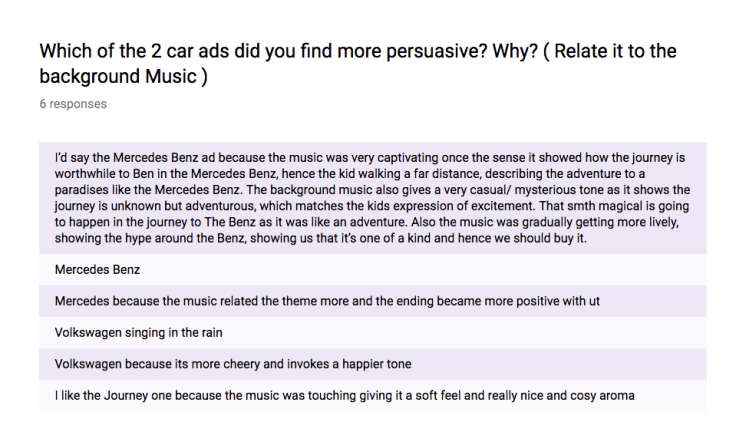
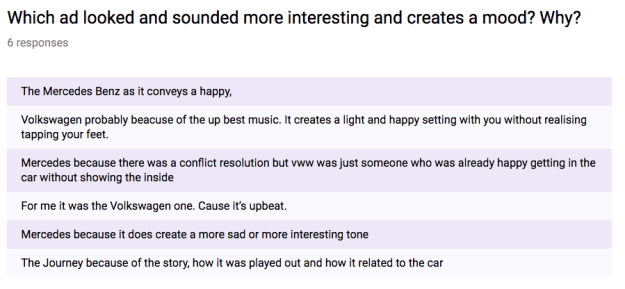
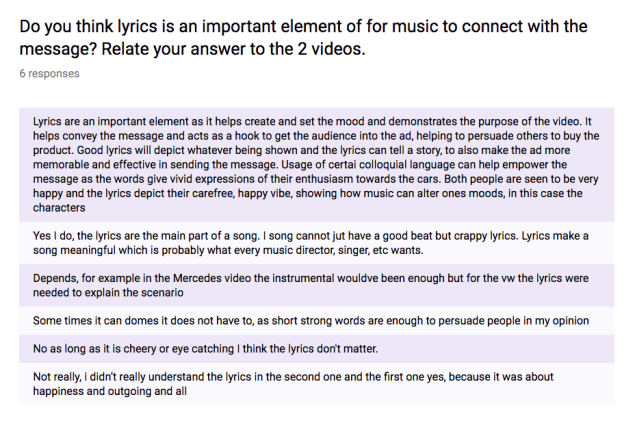
To test out the importance of music in advertisements, I searched for 2 ads about cars with different types of music in the background and made a survey to see the responsiveness of people towards each ad:

Screen Shot 2018-08-15 at 7.39.08 PMScreen Shot 2018-08-15 at 7.39.29 PMScreen Shot 2018-08-15 at 7.39.21 PMScreen Shot 2018-08-15 at 7.39.35 PM

For each of the responses, there was an opinion on both sides of the argument, relating to the relevance of music in the ad.

To sum up, it is an important aspect and strategy to be used by brands within their advertisements as well as branding, and that creating a relationship is necessary in order to persuade them into consuming a particular good or service.


A healthy lifestyle lead with music

When you are out of words but you need to express yourself, you would most likely communicate your emotions by listening, singing, or moving to music.

Music always conveys an emotion,  and people listen to it because it is an emotion that they can relate to and feel, without themselves knowing it, which is why it is used as a form of therapy to manage several medical conditions. It’s effectiveness is supported in areas such as physical rehabilitation, increasing people’s motivation to be engaged in their treatement, providing emotional support and most importantly, an outlet for expression of feelings.

Within therapy, music within a person’s culture is known to be more effective as different types of music evoke a different stimulation within the body.

Though there are several disorders which music can have a positive impact towards, I would mainly be focusing on common ones such as: Dementia, Depression and Insomnia.

Dementia is a loss of cognitive function, and can affect the memory, decision making, thinking, verbal communication, judgement and reasoning of a person. Music therapy is known to reduce symptoms such as aggressive behaviour and improve mood and cooperation with routine tasks. It may also decrease the risk of heart or brain diseases for the senior patients with dementia.

Along with that, depression is another disorder, however, it directly connects to the mood, which music can instantly connect to with its therapeutic effects. It is a disorder that interferes with an individual’s every aspect such as thoughts, behaviour, mood, physical health, and normal habits such as eating and sleeping. Music therapy also helps increase the response towards medication.  For senior patients going through depression, a music therapy program holds long-lasting effects on them. For women suffering from depression, music therapy helps reduce heart rate, blood pressure, depressed mood and respiratory rate. Not only depression but when you feel angry or anxious or other moods, music can always help feel better.

You come home from school and you have a lot of homework, so you stay up late. When its time to sleep, you may have difficulty sleeping or waking up so early for school the next day. This is also known as insomnia and is a disorder that music can also reduce. If the condition does get worse, it may affect an individual’s performance the next day, such as you not being able to pay attention in class and having difficulty learning and remembering. Music has significantly resulted in an increased efficiency in sleeping, longer sleep duration, less disturbance, shorter time needed to fall asleep by listening to meditation music.

My father is a person who has recently been hospitalized, also followed the path of music to help in his recovery, as shown in this interview:

Question: “Would you please tell me about your hospitalization and what role music had on the road to recovery?”

Answer: ” I was in the hospital for 7 weeks, and out of which I was not mobile was 3 whole weeks. I listened to soothing music every now and then to keep myself busy and distracted”

Question: “How often did you listen to music in the hospital”

Answer: “About 3-4 hours a day”

Question: “What type of music did you listen to?”

Answer: “I listened to Hindi music, the radio and some devotional music to soothe my soul”

Question: “Do you think to listen to music had any impact on you?”

Answer” Yes, as the devotional music kept me positive, old romantic songs made me feel lighter and happier, and upbeat and pop music gave energy to me and motivated me while doing physiotherapy”.

Religious Rhythms

Music does not only connect to your mood, but also to your religion, creating a diverse relationship together.

When you hear music from your religion if you have one, what does it sound like to you?

Many say its the voices of god, with the spiritual forms, praised purely through the words, advance beliefs and worshiping them to please a religious and secular life.

Throughout the centuries of the human history, religious pieces or texts, have been sung from the soul and not written, it has become the ‘musical articulation in almost every religion’ as according to the encyclopedia.

Northern Eurasia and inner Asia mainly use music as the prime source of contact to the spiritual world in which they believe.

In the Sinhala traditional region, the priests are the ‘singers’ and the primary carriers are dancers and drummers. Likewise, priests, monks, and other specialists have sung the Buddhist pujas, Christian masses, Islamic callers fro prayers, Hindu sacrifices and various other ceremonies for religions around the world.

Elements such as instruments, forms, and sounds have been used in various cultures to create a musical life for the religions.

In some parts of the world, you may hear it through the form of chants, hums or instrumental music, whereas in other parts of the world it might be through the rhythmic beats from claps and stomps, as well as shouts.

Think about how you use different social media platforms such as Whatsapp, Snapchat, Instagram and many more, to communicate with one another. Just like that, all these forms of music are used to “communicate with the divine, unite religious communities and to express moral, political, social and economic aspirations”, according to Smithsonian music.

Relating back to ‘A healthy lifestyle lead with music’, the vibrations caused by the sounds produced by ‘god’ are known to be healing methods and pathways to an individual’s mind and body.

At one point you may feel joyous but humans have the capability to turn sorrow in the next moment. These capabilities are infused into chants, songs, and poetry, becoming one of the most powerful tools for inspiration in cultures.

Out of the vast traditions of the religions all around the world, some of them implement the use of sacred sounds to bring peace to the state of mind. For example, in the United States, Christianity is the dominant religion which also upholds sacred texts which are seemed to be like sacred sounds; “Make a joyful noise unto the Lord”; “Come before his presence with singing” (Psalm 100: 1-2); “My Lord, He calls me by the thunder… the trumpets sound within my soul…” (from “Steal Away” [African American spiritual]) – Smithsonian Music

Likewise, in other cultures such as in ancient India, and their sacred texts from the Vedics also teach that “The essence of sacred knowledge in word and sound, and the essence of word and sound is OM.”

A-Hindu-Guru-Sri-Sri-leading-a-devotional-meditation-prayer

Sacred sounds are spread amongst cultures as a way to acknowledge consciousness, thoughts, and actions, activities that are further connected with the inner recesses of the universe, despite the fact that many of the religious rituals are esoteric to other cultures.

You come home from school and you are busy with homework, just like your parents coming back from work, only to do more and feel stressed and tensed.

Similarly, many people in the modern world, people are often too busy to find time to visit temples / Churches/ Mosques and are not able to be distracted from a stressed world to collect a calm peace of mind through the connection with the spiritual world. However, when they put on the religious music, the power in the sacred sounds are used to ease the person’s stress and creates a more positive environment for them.

A person who has for a significant amount of times referred to religious music for peace and a relief from stress would be my mother:

Question: “What type of music do you listen to for peace?”

Answer: ” I listened to Buddha mantra meditation music”

Question: “Why do you think it helps you?”

Answer: “It helps me because I receive positive vibes by listening to it. Though I am not Buddhist, it doesn’t matter what type of music you listen to, as long as it helps you to be distracted from the stress of reality”

Question: “Does it help reduce stress and clear your thoughts? Explain.”

Answer: “Yes, as my negativity goes away and I feel more lighter and relaxed after listening to this meditation music.


Create a free website or blog at WordPress.com.

Up ↑

Design a site like this with WordPress.com
Get started